
Guide to choosing a proxy for business
11/11/2025
Proxy has long ceased to be just a convenient option. It has become an essential tool for everyday business operations. A properly chosen proxy allows for secure interaction with external resources, automates operations, and gathers critical data while reducing risks and costs.
Proxies enhance the security of corporate systems. They hide the real IP addresses of servers and employees, reduce the attack surface, help mitigate DDoS and targeted intrusions, and enable centralized control and filtering of outgoing and incoming traffic.
For scaling operations, proxies allow load distribution during large-scale automated requests and help overcome speed and request-count limitations. Using proxies helps maintain service stability as workloads grow and reduces the risk of bans from external platforms.
From an analytical perspective, proxies provide access to resources from different geolocations and IPs, which increases the accuracy of price monitoring, ad verification, and competitive intelligence. Without proxies, results may be distorted due to caching or personalized displays, whereas proper proxy configuration ensures accurate and comparable data.
What Proxies Mean for Business
In a business context, a proxy is an intermediary between your services (or employees) and external resources on the internet. When your server or browser connects to a site via a proxy, the request does not come directly from your real IP but from the proxy server’s address. The proxy can also filter, cache, and log traffic, replace geolocation, and manage sessions.
The Difference Between Regular Proxy Use and Corporate Tasks
For a private user, simple proxies are usually sufficient: one or two addresses for privacy or bypassing geo-restrictions, browser configuration, and occasional requests. For businesses, things are far more complex.
Companies need large pools of addresses, automatic rotation (to avoid blocks during mass requests), high speed, stability, logging for audits, and integration with internal systems. Moreover, business proxies are often used as part of security measures to hide real servers, filter traffic, and manage access.
Corporate proxies are also integrated with automated processes (scripts, scrapers), have API management capabilities, provider support, and often include legal aspects (usage agreements, compliance with privacy and local regulations).
- In other words, while private users prioritize simplicity and personal privacy, businesses need scalability, management, reliability, and compliance with security and analytics requirements.
Business Tasks Solved by Proxies
Proxies in business address a wide range of practical tasks—from infrastructure protection to ensuring accurate data and scaling automated processes.
Security and Infrastructure Protection
Proxies serve as the first layer of traffic filtering and help restrict access to internal services. They allow centralized blocking of unwanted sites, filtering of malicious traffic, connection logging for audits, and minimizing the attack surface.
Scaling Automated Tasks and Resistance to Blocks
When performing a large number of requests to external resources (scraping, mass registration, automated testing), a single IP quickly runs into limits or blocks. Proxies distribute the load across multiple addresses, automate IP rotation, and keep scripts and services stable as volume grows. This makes it possible to scale processes without interruptions.
Data Collection and Accurate Monitoring from Different Locations
For price monitoring, ad verification, content checks across countries, and competitive intelligence, access to resources “as if from another region” is crucial. Proxies provide access from the desired country and help avoid distortions caused by personalization, caching, or local blocks.
Testing, QA, and Development
Proxies help test how services behave for users in different regions, check localization, simulate network conditions, and conduct testing without revealing internal addresses. For example, you can run payment or content-display scenarios from a client’s regional IP without physically traveling to another country.
Anti-Fraud and Protection Against Competitive Interference
Proxies help conceal internal addresses when interacting with external platforms, reducing the risk of targeted attacks, data manipulation, or monitoring by competitors.
Key Criteria for Choosing Business Proxies
When selecting a proxy for business, it’s important to focus on the specific technical and commercial parameters that directly affect the efficiency and reliability of your processes.
-
Connection reliability and speed determine how stable your requests will be and how quickly responses are processed.
-
IP geography is critical if your tasks involve local access or measurements across different regions.
-
Scalability and size of the IP pool are vital for large-scale automated operations.
-
Support for required protocols and authentication methods ensures compatibility with your tools. Make sure your provider supports HTTP/HTTPS and SOCKS5, and offers convenient authorization options and a management API.
-
Price-to-value ratio should be evaluated in terms of total cost of ownership, not just price per IP. A cheap plan might require extra manual maintenance, frequent switching, or downtime compensation. Assess the presence of SLAs, support quality, log availability, and monitoring tools—all these factors impact overall cost efficiency.
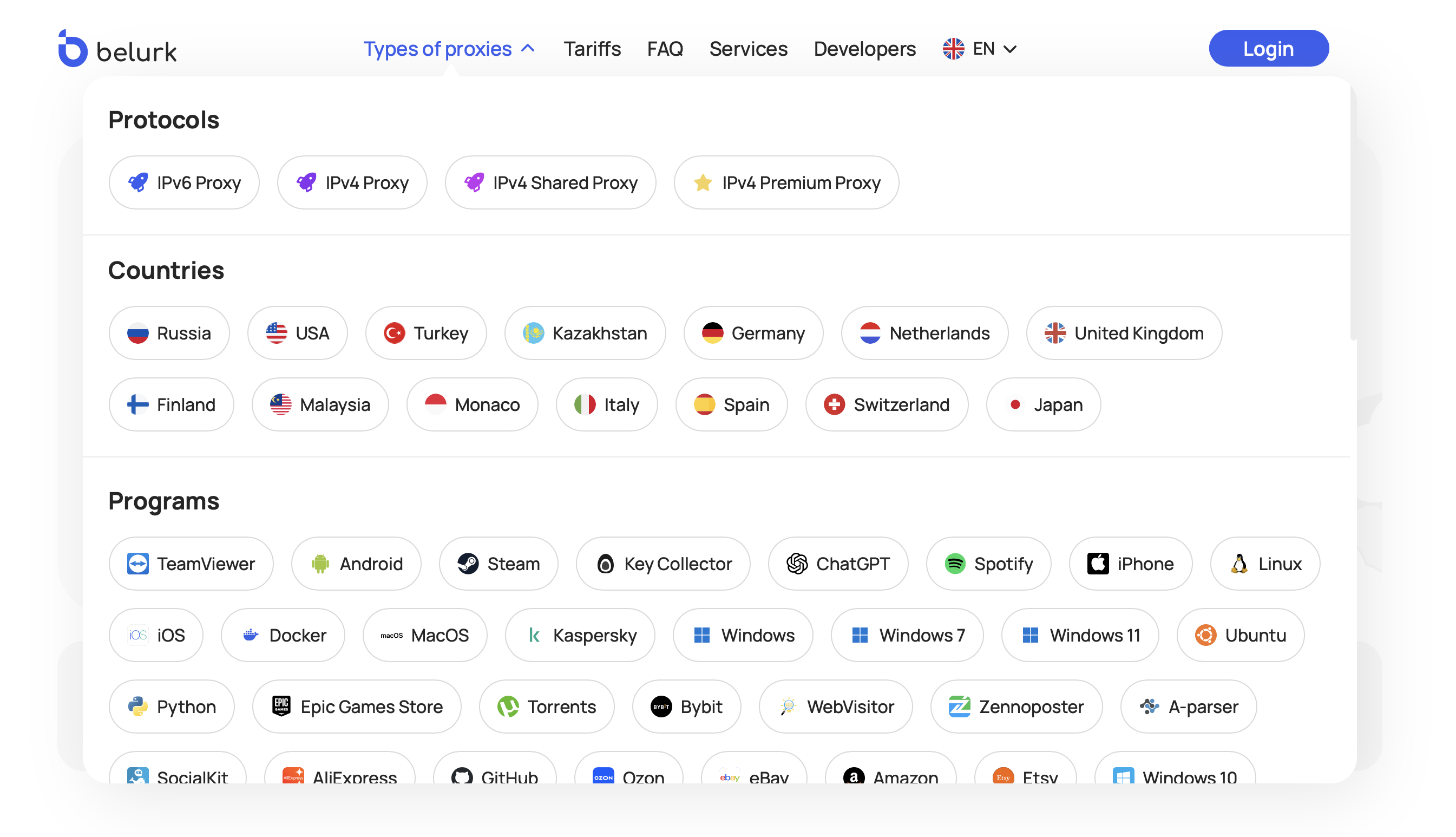
Belurk meets these criteria. With Belurk, you save setup time: ready-made geolocations for your target markets, automatic IP rotation, and transparent statistics let you quickly identify where and why issues occur—and fix them before they affect your business metrics. Need integration with a scraper or CRM? APIs make this connection simple and secure.
Try belurk proxy right now
Buy proxies at competitive prices