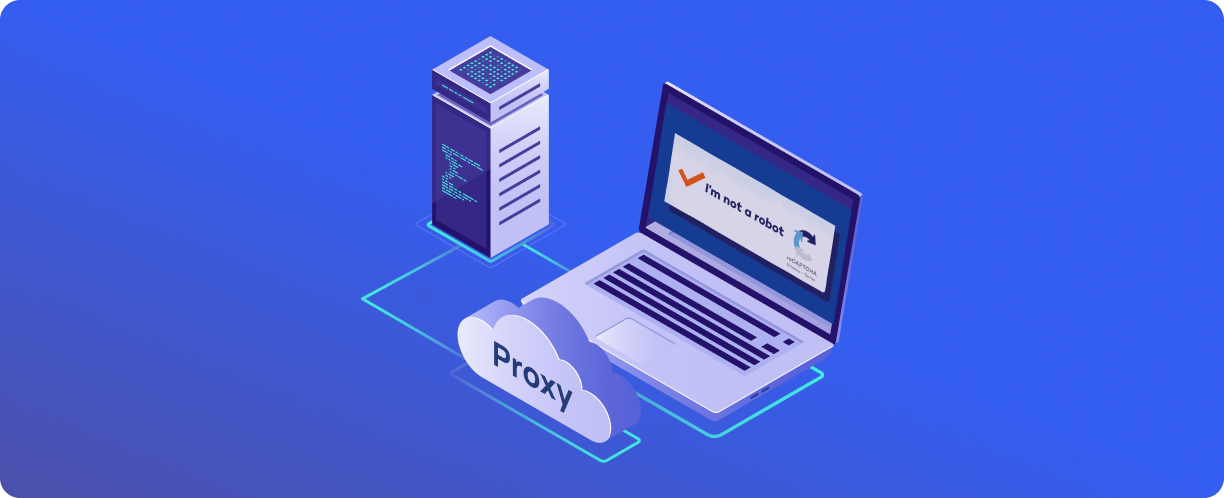

Proxies and Captchas: What's Important to Consider When Automating
31.03.2026Automation of interactions with websites via proxies and CAPTCHAs often becomes a challenge. Requests that are too frequent lead to blocking, forcing constant IP changes. Maintaining a stable data flow requires continuous monitoring and fine-tuning, while IP reputation and geographic location strongly influence the responses you receive, often triggering repeated CAPTCHAs. Any attempts to bypass protection mechanisms carry risks of violating rules and laws.
Why websites show CAPTCHAs
Websites use CAPTCHAs as a filter to distinguish real users from automated traffic. The signals used by the system to make decisions are formed from several layers.
- The first is request frequency. If you send requests too often and in short intervals, you appear to be a bot.
- The second is repetitive patterns. A uniform sequence of actions without natural variation, such as visiting the same pages in the exact same order.
- The third is external signals that form a “user signature.” The reputation of the IP address and its geography, browser settings and fingerprint data, and behavior during the session.
It is also important to consider factors such as the absence of proper cookies and sessions, overly “clean” interactions without typical human clicks and mouse movements, and attempts to bypass dynamic content. Together, all these signals create a profile, and ultimately the website does not see a person but a set of indicators. If they raise suspicion, a CAPTCHA appears as an additional verification step.
How proxies affect the likelihood of CAPTCHAs
IP address reputation
The quality of the address directly affects how the system perceives traffic. Addresses with a good reputation are more often treated as legitimate sources, which can reduce the frequency of CAPTCHAs. If an IP is already associated with bots or is blacklisted, the likelihood of additional checks increases.
Geographic location of addresses
Geography plays a role in content localization and service expectations. An IP from an expected region appears more natural to the website and suggests that the user is not violating regional restrictions. Unexpected geographic changes or mismatches with the actual user location often increase the likelihood of additional verification.
Connection stability
The connection through a proxy should be stable and predictable. Errors, long delays, and sudden disconnections may appear as instability and can trigger additional checks.
Proxy rotation
Changing addresses can reduce the risk of all traffic being treated as a single source and subjected to stricter scrutiny. However, overly frequent or abrupt changes can also trigger CAPTCHAs. The goal is to maintain a balance between a natural request flow and moderate IP changes that simulate real user behavior without activating protection mechanisms.
Behavioral factors: what to consider
- The speed of sending requests affects how your traffic is perceived by protection systems. If requests are too fast or follow a constant pattern over time, the website may classify them as automated. Your task is to maintain a reasonable dynamic flow without sharp spikes or monotonous repetition.
- Intervals and random pauses create a natural sequence of actions typical for a human. In real scenarios, there are varying delays between clicks, page views, and navigation: sometimes users engage with content, sometimes they wait for loading, and sometimes they pause before the next step. Introduce variability so that delays change within a reasonable range and do not repeat in a fixed pattern.
- Alternating actions such as navigation, clicks, and transitions. To appear natural, visit different pages within a section, perform random clicks and scrolling, and pause on content.
Simulating real user behavior should always be based on ethics and legitimate data usage. The goal is not to deceive protection systems but to ensure that your scenarios reflect real user behavior within permitted conditions.
Common mistakes when working with proxies and CAPTCHAs
Lack of or improper proxy rotation
Using a single IP for a long time leads to frequent checks by the service. If the system sees one source, the risk of additional verification increases, so reasonable rotation is a natural step toward stable operation. However, changes should appear as normal user behavior rather than attempts to hide the source.
Using low-quality addresses
Proxies with poor reputation are often associated with bots and blacklists, leading to frequent CAPTCHAs. Address quality directly affects server behavior and the frequency of checks, so it is better to invest in reliable, clean IPs that match your task and region.
Overly aggressive automation pace
A fast, monotonous stream of requests without pauses or adaptation to server responses quickly raises suspicion and may result in blocks or additional CAPTCHAs. Avoid sharp spikes in load, even if the task requires processing large volumes of data.
Practical recommendations
Start with a clear understanding of legality and the rules of the target resource
If official APIs or permitted methods of data access are available, use them—this reduces the risk of conflicts and CAPTCHAs. Choose proxies carefully, prioritizing quality and good IP reputation. High-quality IP addresses significantly reduce the likelihood of CAPTCHAs. Match the region to the content you are collecting so that server responses remain predictable and aligned with user expectations.
IP rotation should be moderate and well planned
Do not use a single address for too long, but also avoid changing them too frequently. Plan rotations so they appear natural within a session and do not break user behavior logic. If switching regions, do so within reasonable dynamics so the website does not treat the activity as suspicious.
Simulating real behavior = moderate delays and variability in scenarios
Request speed should be appropriate. Introduce random pauses, alternate navigation, clicks, and scrolling, and include small delays for content loading.
Pay attention to monitoring and logs
Store session details, delay timings, used proxies, and geographic data so you can quickly adjust your strategy.
A good proxy service should provide clear IP quality statistics, a convenient API, and flexible rotation settings. Belurk offers wide geographic coverage, well-designed IP rotation, and user-friendly monitoring tools to help reduce CAPTCHA risks without violating rules. Working with proxies and CAPTCHAs requires a balance between automation efficiency and responsible data usage. The Belurk proxy service is a solution for stable and ethical automation.
Try belurk proxy right now
Buy proxies at competitive prices
Buy a proxy